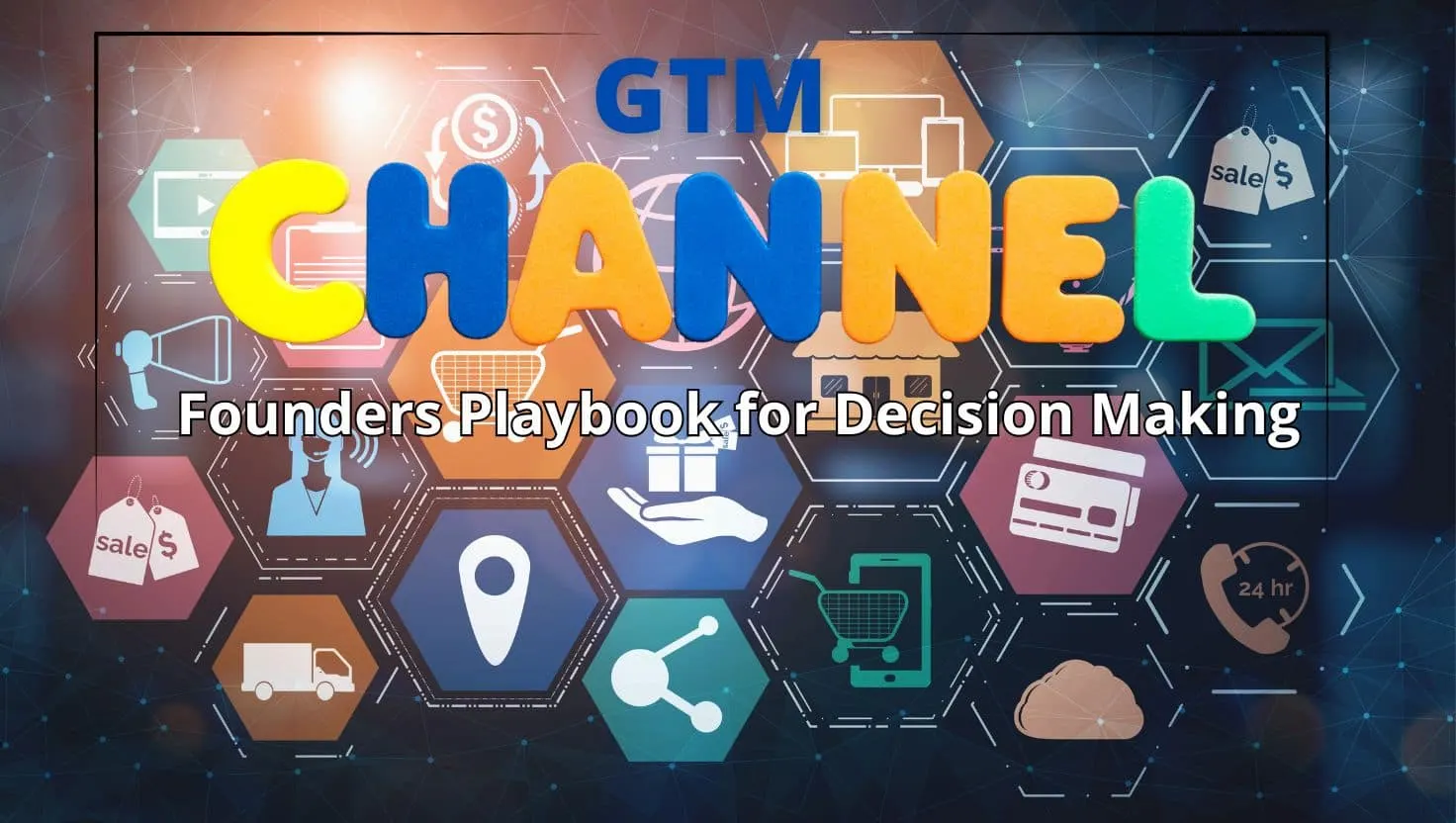
Crafting a winning Go-to-market strategy begins with one critical choice: your GTM channel. This decision, whether it’s D2C for ultimate brand control and rich customer data, competitive Online Marketplaces for rapid validation, or General Trade/Wholesale for massive scale, will make or break your launch.

Many founders burn through cash by choosing a channel misaligned with their goals. This definitive guide breaks down the pros, cons, and ideal scenarios for each path, empowering you to choose wisely a channel strategy that protects your profit margins, fuels sustainable growth, and builds a lasting brand.
You’ve done it. You’ve poured your heart, soul, and countless hours into perfecting your product. The packaging is pristine, the branding is sharp, and you’re ready to conquer the world. But now you face the most critical strategic decision since the initial idea: Where do you actually sell it?
This isn’t just a logistical choice; it’s your first and most defining Go-To-Market (GTM) strategy. Your choice of sales channel dictates everything: how fast you learn, how much you control, how you interact with customers, and ultimately, whether your business burns bright or burns out.
There’s a fundamental truth in business strategy: If you can’t win in a controlled environment, you won’t win in a chaotic one. Your initial channel is that controlled environment—your training ground. Choose wrong, and you’ll be learning to swim by being thrown into the deep end during a storm.
Today, we’re breaking down the three primary GTM channel archetypes: the massive General Trade, the competitive Marketplaces, and the sovereign Direct-to-Consumer (D2C) route. By the end of this guide, you’ll know exactly which one aligns with your objectives and how to approach it for maximum success.
If You Wish to connect with me offline DM me Jagdeep Singh
The GTM Channel Trinity: A Macro View
Before we dive deep, let’s define our terms. A Go-To-Market channel is simply the path a product takes to reach its end customer. It’s the ecosystem where the transaction happens.
Primary Goal
Each channel serves a distinct strategic purpose. General Trade is fundamentally designed for scale and ubiquity, aiming to place your product on as many physical shelves as possible to achieve mass-market penetration. Online Marketplaces prioritize validation and volume, providing a platform to quickly test product-market fit and generate significant sales numbers through a vast, built-in audience.
In contrast, Direct-to-Consumer (D2C) focuses on control and connection, allowing you to own the entire customer relationship and build a dedicated community around your brand, rather than just moving units.
Brand Control
The level of influence you have over your brand’s presentation varies drastically. In General Trade, your brand control is low; once your product is on a retailer’s shelf, it is surrounded by competitors and you have no say over its placement or the in-store experience.
Online Marketplaces offer medium control; you can customize your product page within the strict confines and algorithms of the platform, but you are still one of many and must adhere to their rules. D2C provides high control, giving you complete sovereignty over your website’s design, narrative, customer journey, and overall brand experience.
Customer Data
Access to customer insights is a critical modern asset. General Trade provides minimal data; you typically only receive bulk sales figures from distributors or retailers, with no visibility into who the end customer is or why they bought.
Online Marketplaces grant limited, second-party data; you get analytics on sales and customer queries through the platform’s dashboard, but this data belongs to the marketplace and is not directly owned by you. D2C delivers full, first-party data; you own the information of every customer, including their email, purchase history, and behavior, which is invaluable for personalization and retention.
D2C Market in India (2023-2025): Trends, Size, Growth & Support Ecosystem
Margins
Profitability structures differ across channels. General Trade features lower, shared margins; your profit per unit is reduced because it must be split between your brand, the distributor, and the retailer, each taking their cut.
Online Marketplaces have variable margins; your profitability is heavily influenced by platform commission fees, advertising costs, and the pressure to compete on price, which can quickly erode earnings. D2C offers higher, theoretical margins; by cutting out intermediaries, you keep the entire profit, but this is theoretical until you subtract the potentially high costs of marketing and customer acquisition.
Traffic
The source of your customers is a key differentiator. General Trade benefits from built-in retail footfall; your product gains exposure to the existing stream of shoppers who physically visit the stores where you are stocked.
Online Marketplaces also thrive on built-in traffic from the platform’s millions of daily users who are already in a commercial mindset, ready to browse and buy. D2C requires all traffic to be self-generated; you must proactively attract visitors to your own website through marketing efforts like SEO, social media, and paid advertising, as there is no natural footfall.
Complexity
The operational challenge of each model is unique. General Trade is highly complex; it involves navigating intricate logistics, managing relationships with distributors and buyers, and dealing with long payment cycles and high minimum order quantities.
Online Marketplaces pose a medium complexity; the main challenges are mastering the platform’s specific rules, algorithms, and advertising systems to stand out in a crowded field. D2C also has medium complexity, but it is focused on the difficult and continuous task of customer acquisition and retention in a vast digital landscape.
Best For
Each channel is ideally suited for a specific stage or type of business. General Trade is best for scaling a proven winner; it is the path for established brands that have validated demand and are now seeking mass-market distribution.
Online Marketplaces are ideal for testing demand quickly; they are the perfect launchpad for new products to gauge consumer interest and achieve initial sales volume with minimal setup. D2C is the choice for building a lasting brand; it is designed for founders who want to own their customer relationship, tell a unique story, and create a long-term, sustainable business.
D2C Brand Marketing Playbook for Founders
The Arena – Online Marketplaces (Amazon, Flipkart, etc.)
You walk into a colossal, digital colosseum. On one side, millions of potential customers. On the other, thousands of competitors, all vying for the same attention. This is the world of online marketplaces.
The Promise: Instant Traffic and Built-in Trust
The single biggest advantage of platforms like Amazon, Flipkart, Walmart.com, or Etsy is their immense, pre-existing traffic. You don’t have to spend months and a fortune convincing people to visit an unknown website; they are already on Amazon, credit card in hand, ready to buy.
You are plugging into a powerful commerce engine. Furthermore, these platforms have earned a level of consumer trust that a new brand can leverage—the trust is in the transaction process itself.
The Peril: The Algorithm is Your Landlord
This convenience comes at a cost. You are essentially renting space in someone else’s empire. You must play by their rules, which can change at any time. Your success is often at the mercy of a black-box algorithm that dictates visibility. This leads to:
- Cut-throat Competition: You are often just a thumbnail in a sea of identical products.
- Price Wars: With comparison shopping made effortless, competing on price becomes a race to the bottom, eroding your margins.
- Fees: Platform commissions, advertising costs, and fulfillment fees can quickly add up, squeezing profitability.
Who Should Enter the Arena?
Marketplaces are ideal for validating product-market fit. If your product can win and get traction here amidst the fiercest competition, it has legs. It’s also excellent for brands where the product is truly differentiated by specs or price, and less by a nuanced brand story.
The Fortress – Direct-to-Consumer (D2C)
If marketplaces are a rented arena, D2C is your own fortified castle. You own the land, you make the rules, and you have a direct line to everyone inside.
The Promise: Ultimate Control and Rich Customer Data
This is the channel of building. With your own website (via Shopify, WooCommerce, etc.), you have complete control over:
- Your Story: How you present your brand, your mission, and your products without competing ads or distractions.
- Your Margins: You keep the entire margin (minus payment processing fees), giving you more room to invest in growth and customer experience.
- Your Customer Data: This is the crown jewel. You know who your customers are, what they buy, and how they behave. This allows for personalized marketing, loyalty programs, and invaluable insights for product development.
The Peril: The Burden of King and Kingdom
The downside? Everything is on you. There is no built-in traffic. You are responsible for every visitor, which means mastering and funding the complex arts of digital marketing: SEO, social media, email marketing, and paid ads. Scaling traffic is hard and expensive.
Your Customer Acquisition Cost (CAC) must be carefully managed against the Lifetime Value (LTV) of a customer. It’s a slow, deliberate build, not an instant splash.
Who Should Build a Fortress?
D2C is perfect for brands, not just products. If you have a strong story, a passionate community, or a niche product, D2C allows you to foster that connection. It’s for founders who want to build a long-term asset and for whom customer relationships are a primary competitive advantage.
7 Proven Strategies for D2C Ecommerce SEO Dominance
The Empire – General Trade & Wholesale
This is the path of legacy scale. It’s about getting your product onto the shelves of major retail chains, local boutiques, and everything in between.
The Promise: Unparalleled Scale and Tangible Trust
There’s a magic in seeing your product on a physical shelf. It confers a level of legitimacy that online sales sometimes can’t match. General Trade offers access to a massive, diverse audience that might not discover you online. It’s about ubiquity—becoming a household name by being in households’ local stores.
The Peril: The Slow, Costly Grind
This scale is arguably the hardest to achieve from a cold start. The barriers are high:
- Costly to Begin: You need to produce at volumes that meet retailer Minimum Order Quantities (MOQs), often with extended payment terms (e.g., net 60 or 90 days). This requires significant working capital.
- Opaque Feedback: How is your product performing in a specific store? Why did it sell well one week and not the next? This data is slow, fragmented, and hard to get. Without tight feedback loops, you can burn cash fast on inventory that isn’t moving, without knowing why.
- Complex Relationships: You’re now dealing with distributors, buyers, and logistics networks—a world of relationships and negotiations far removed from a simple “buy now” button.
Who Should Build an Empire?
General Trade is typically a channel for scaling, not starting. It’s for brands that have already proven demand through D2C or marketplaces and now need the machinery to achieve mass-market distribution. It’s for products with broad, general appeal.
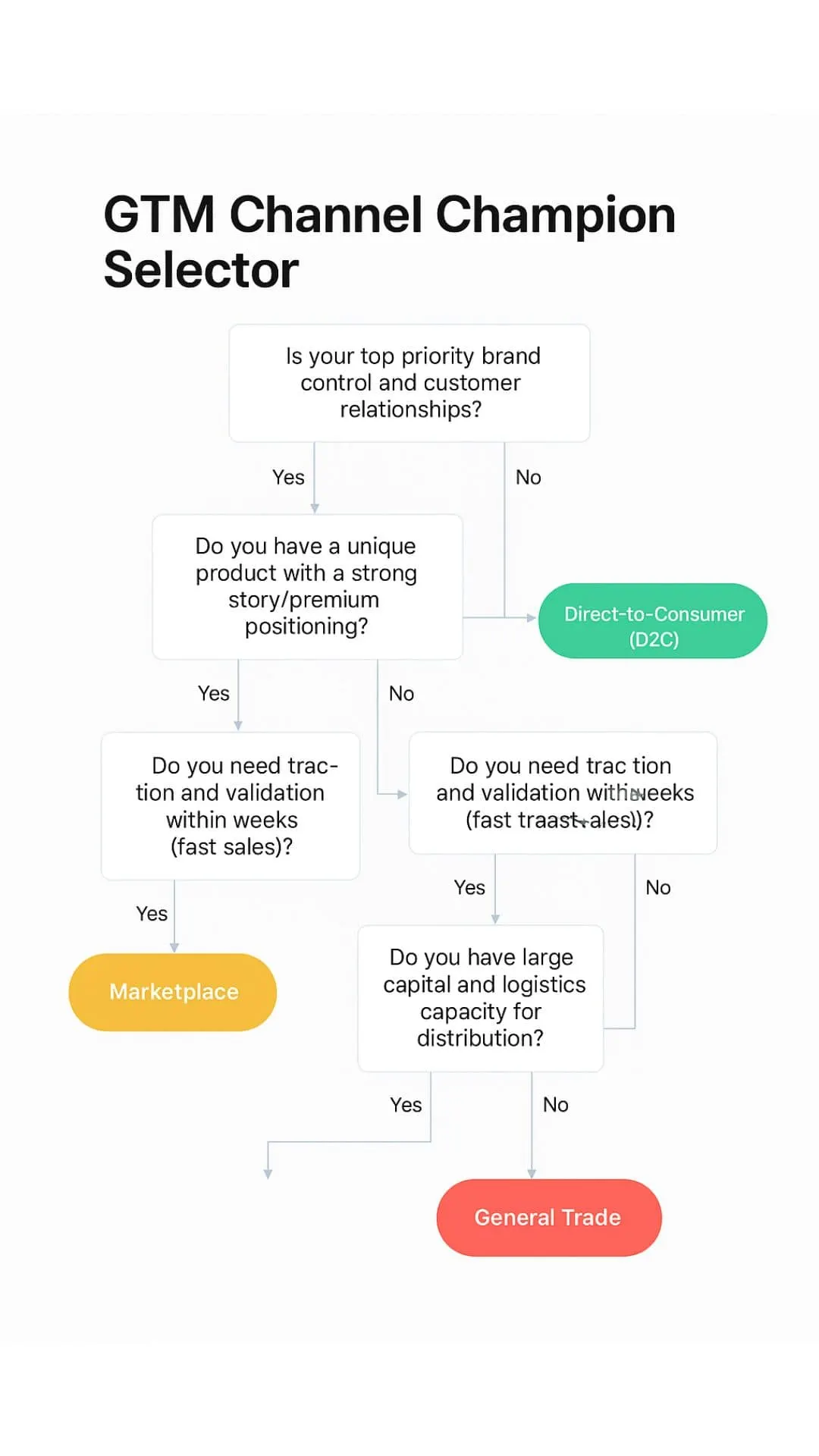
How to Choose – Aligning Channel with Objective
So, with these three paths before you, which do you take? The answer lies in asking one simple question: “What is my primary objective right now?”
- Objective: To Prove Product Pull → Choose Marketplaces.
If you need to know, quickly and ruthlessly, if anyone will buy your product, the arena is your best test. Let the market decide. - Objective: To Build a Brand and Learn → Choose D2C.
If your goal is to build a deep, lasting connection with a community and own your entire customer journey, start building your fortress. The controlled environment of your own site is the best place to learn who your customer truly is. - Objective: To Achieve Ubiquity → Expand to General Trade.
Once you have a proven winner, use the data and revenue from your other channels to fuel a wholesale expansion. Never start here unless you have the capital and demand to back it up.
Your strategy shouldn’t be “either/or” but “where first?” Your initial channel is your primary learning ground. Start on the channel that you can control the most and learn the fastest from.
The Hybrid Horizon – Building a Channel Ecosystem
The end goal for most successful modern brands is not to rely on a single channel but to build a resilient, omnichannel presence. Each channel should serve a strategic purpose and feed the others.
- Use your Marketplace presence as a lead generator and social proof machine. Customers discover you on Amazon, love you, and then sign up for your newsletter on your website.
- Use your D2C website to build your email list, test new products, and gather rich data that makes you a more valuable partner to retailers.
- Use General Trade to build brand awareness and credibility, which in turn lowers the cost of acquisition on your D2C channel.
Think of it as a flywheel: each channel spins the others, creating a system that is greater than the sum of its parts. However, caution: don’t try to be everywhere at once from day one. Master one channel first, then strategically expand.
Your Channel, Your Choice
The path you choose to launch your product is more than a distribution decision; it’s a statement of your strategy. It defines how you learn, how you grow, and who you are as a business.
Remember the principle: win in a controlled environment first. Whether that’s the controlled chaos of a marketplace or the sovereign ground of your own website, choose the arena that gives you the best chance to learn, adapt, and prove your value.
There is no single “best” channel. There is only the best channel for you, right now, based on your goals. So, take a step back. Audit your objective. Be honest about your resources. And choose wisely.
Choosing the wrong GTM channel can burn cash fast. Our guide breaks down D2C, Marketplaces, and General Trade to help you align your channel strategy with your growth goals. Learn how to choose wisely.